Research Ireland Centre for Advanced Materials and BioEngineering Research
Follow




Over 500 million years ago, nature evolved a remarkable trick: generating vibrant, shimmering colours via intricate, microscopic structures in feathers, wings and shells that reflect light in precise ways. This “structural colour” has continued to fascinate and perplex scientists—but now, researchers from Trinity College Dublin have taken a major step forward in harnessing it for advanced materials science.
A team, led by Professor Colm Delaney from AMBER and Trinity College Dublin’s School of Chemistry has developed a pioneering method, inspired by nature, to create and programme structural colours using a cutting-edge microfabrication technique.
“Collaboration has been key to this discovery, as it has been the combination of chemistry, materials science, and physics that has ultimately enabled us to harness an ability that nature and its weird and wonderful creations have been perfecting for millions of years,” said Prof. Delaney, noting the contributions of fellow investigators at AMBER, Prof. Larisa Florea (School of Chemistry, TCD) and Prof. Louise Bradley (School of Physics, TCD). “From ancient feathers to next-generation medical sensors, the future of colour is brighter—and smaller—than ever.”
The work, which has been funded by a prestigious European Research Council (ERC) Starting Grant, could have major implications for environmental sensing, biomedical diagnostics, and photonic materials.
At the heart of the breakthrough is the precise control of nanosphere self-assembly—a notoriously difficult challenge in materials science. Teodora Faraone, a PhD Candidate at Trinity, used a specialised high-resolution 3D-printing technique to control the order and arrangement of nanospheres, allowing them to interact with light in ways that produce all the colours of the rainbow in a controlled manner.
“This was the central challenge of the ERC project,” said Prof. Delaney, who is en route to Purdue University to present the landmark findings at the MARSS conference on microscale and nanoscale manipulation. “We now have a way to fine-tune nanostructures to reflect brilliant, programmable colours.”
One of the most exciting aspects of the newly developed material is its extreme sensitivity: the structural colours shift in response to minute changes in their environment, which opens up new opportunities for chemical and biological sensing applications.
Dr Jing Qian, a postdoctoral researcher and computational specialist on the team, helped confirm the experimental results through detailed simulations, providing deeper insights into how the nanospheres organise themselves.
The team is already combining the colour-programming technique with responsive materials to develop tiny microsensors that change colour in real time. These sensors are being developed as part of the IV-Lab Project, a European Innovation Council Pathfinder Challenge led by the Italian Institute of Technology, with a key goal being the development of implantable devices capable of tracking biochemical changes inside the human body.
The work is described in leading journal Advanced Materials and can be read Open Access at: https://advanced.onlinelibrary.wiley.com/doi/full/10.1002/adma.202504116.
Coverage of this work featured in the Irish Independent here: https://www.independent.ie/irish-news/natures-ability-to-appear-to-change-colour-replicated-by-tcd-scientists/a2005835893.html
This research was funded by the European Research Council, Taighde Éireann – Research Ireland, the European Innovation Council and the Chinese Scholarship Council.
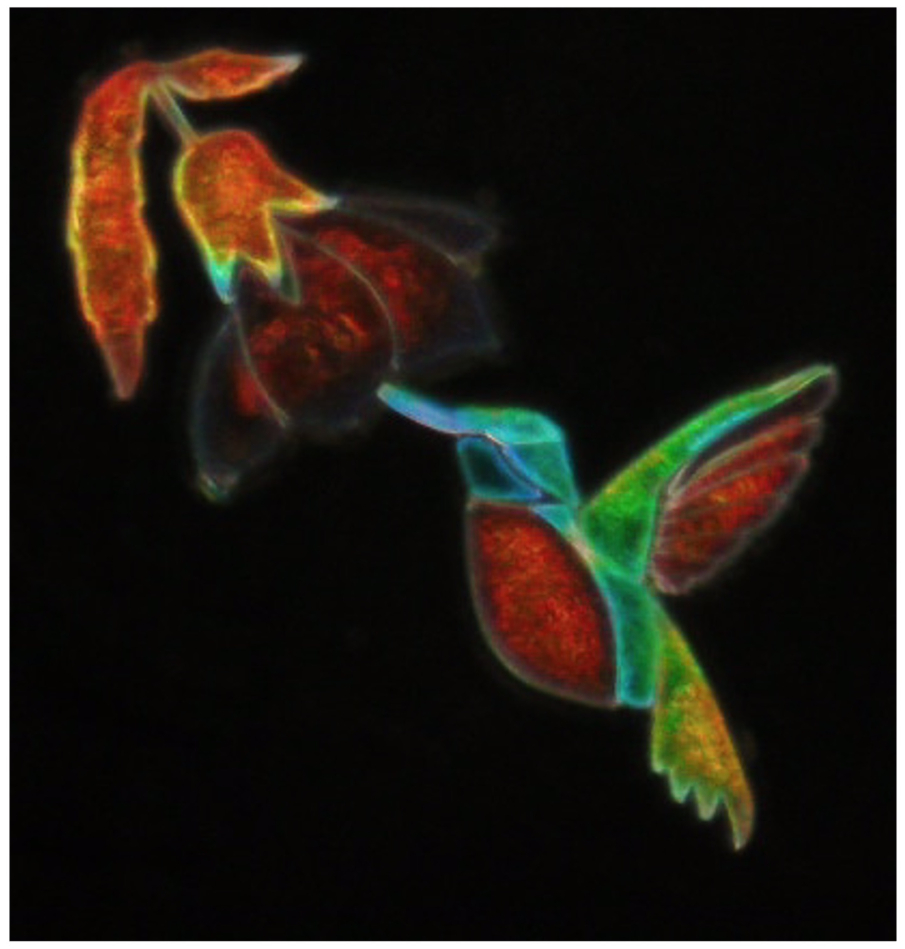
Image: Microscopic pixels fabricated using direct laser writing, demonstrating the ability to achieve wide gamut structural colours, and to combine these into microscopic works of art. Credit: Prof. Colm Delaney, Trinity College Dublin.
AMBER has a strong emphasis on collaboration. Central to AMBER’s research remit are collaborative projects performed with industry partners, and working with academic, industry and wider stakeholder on international and national research programmes.
Get in touch