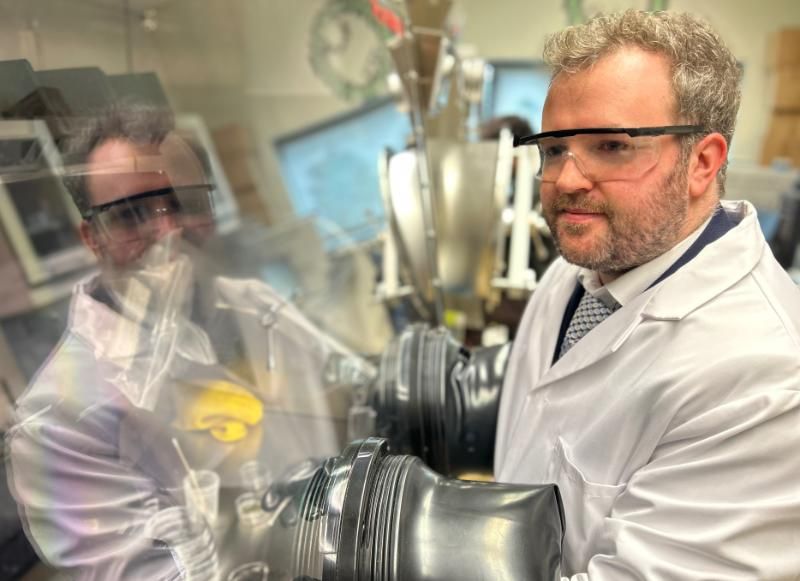
AMBER Researcher Dr Carey, from Trinity’s School of Physics will now build an independent research group in Trinity.
Research Ireland Centre for Advanced Materials and BioEngineering Research
Follow




AMBER Researcher Dr Carey, from Trinity’s School of Physics will now build an independent research group in Trinity.
URFs, awarded to outstanding scientists in the early stages of their research careers, and to those with the potential to become leaders in their fields, provide salary costs and research expenses for up to eight years.
Dr Carey will now grow his team and lead a project that will develop printed electronics using two-dimensional (2D) materials – specifically field-effect transistors (FETs) and circuits, which make up some of the fundamental building blocks of modern computing.
He said: “I feel incredibly fortunate to receive this award, which will allow me to establish an independent research group at Trinity and to capitalise on the research momentum over the last decade in 2D material transistors, circuits and sensors.”
The broader impact of this work is substantial as printable electronics have the potential to transform how electronic systems are manufactured, enabling low-cost, scalable production on flexible substrates, such as clothing for wearable electronics.
A central objective of the project is to address the performance bottlenecks that currently limit charge transport in printed transistors, thereby unlocking their use in advanced sensing and signal-processing applications on unconventional surfaces.
The work also has significant potential to produce sensors that could be used for non-invasive diagnostic and monitoring technologies, with the obvious big-picture impact being the possibility of identifying health conditions earlier and dramatically improving outcomes.
“Catching a disease at an early stage can reduce treatment costs by up to an order of magnitude and increase survival rates by a similar factor,” added Dr Carey.
“Overall, the societal impact of this research could be immense, as the project could also lead to advances beyond healthcare, such as delivering improved environmental monitoring capabilities and consumer electronics, ultimately enhancing quality of life and reducing the costs associated with traditional silicon technology manufacturing.”
In related news, Dr Carey recently published research in leading international journal Nature Communications, which highlighted a nano breakthrough with a huge potential impact – one that puts printable electronics on the horizon.
The recently published journal articles can be read on the Nature Communications website.
AMBER has a strong emphasis on collaboration. Central to AMBER’s research remit are collaborative projects performed with industry partners, and working with academic, industry and wider stakeholder on international and national research programmes.
Get in touch