Research Ireland Centre for Advanced Materials and BioEngineering Research
Follow




An interdisciplinary AMBER research team from RCSI University of Medicine and Health Sciences and Trinity College Dublin has developed a 3-D printed implant to deliver electrical stimulation to injured areas of the spinal cord offering a potential new route to repair nerve damage.
Details of the 3-D printed implant and how it performs in lab experiments have been published in the journal Advanced Science.
Spinal cord injury is a life-altering condition that can lead to paralysis, loss of sensation and chronic pain. In Ireland, more than 2,300 individuals and families are living with spinal cord injury, but no treatment currently exists to effectively repair the damage. However, therapeutic electrical stimulation at the injury site has shown potential in encouraging nerve cells (neurons) to regrow.
“Promoting the regrowth of neurons after spinal cord injury has been historically difficult however our group is developing electrically conductive biomaterials that could channel electrical stimulation across the injury, helping the body to repair the damaged tissue” explains AMBER Deputy Director Professor Fergal O’Brien, Deputy Vice Chancellor for Research and Innovation RCSI and Head of RCSI’s Tissue Engineering Research Group (TERG). “The unique environment provided by the AMBER Centre which sees biomedical engineers, biologists and material scientists working together to solve grand societal challenges provides a major opportunity for disruptive innovation such as this”.
The study was led by researchers at RCSI’s TERG and the Research Ireland Centre Advanced Materials and Bioengineering Research (AMBER). The team used ultra-thin nanomaterials from Prof. Valeria Nicolosi’s laboratory in the School of Chemistry and AMBER at Trinity College Dublin which are normally used for applications like battery design and integrated them into a soft gel-like structure using 3-D printing techniques.
The resulting implant mimics the structure of the human spinal cord and features a fine mesh of tiny fibres that can conduct electricity to our cells. When tested in the lab, the implant was shown to effectively deliver electrical signals to neurons and stem cells, enhancing their ability to grow.
Modifying the fibre layout within the implant was also found to further improve its effectiveness.
“These 3D-printed materials allow us to tune the delivery of electrical stimulation to control regrowth and may enable a new generation of medical devices for traumatic spinal cord injuries” said Dr Ian Woods, Research Fellow at TERG and first author of the study. “Beyond spinal repair, this technology also has potential for applications in cardiac, orthopaedic and neurological treatments where electrical signalling can drive healing.”
The RCSI and AMBER researchers teamed up with the Irish Rugby Football Union Charitable Trust (IRFU-CT) on the project and brought together an advisory panel to oversee and guide the research. The group included seriously injured rugby players, clinicians, neuroscientists and researchers.
“Through their expertise, the advisory panel helped deepen our understanding of the lived experiences of individuals with spinal cord injuries, their treatment priorities and emerging treatment approaches” said Dr Woods. “Our regular meetings allowed for a consistent exchange of input, ideas and results.”
The study was supported by the Irish Rugby Football Union Charitable Trust, AMBER the Research Ireland Centre for Advanced Materials and BioEngineering Research and an Irish Research Council Government of Ireland Postdoctoral Fellowship.
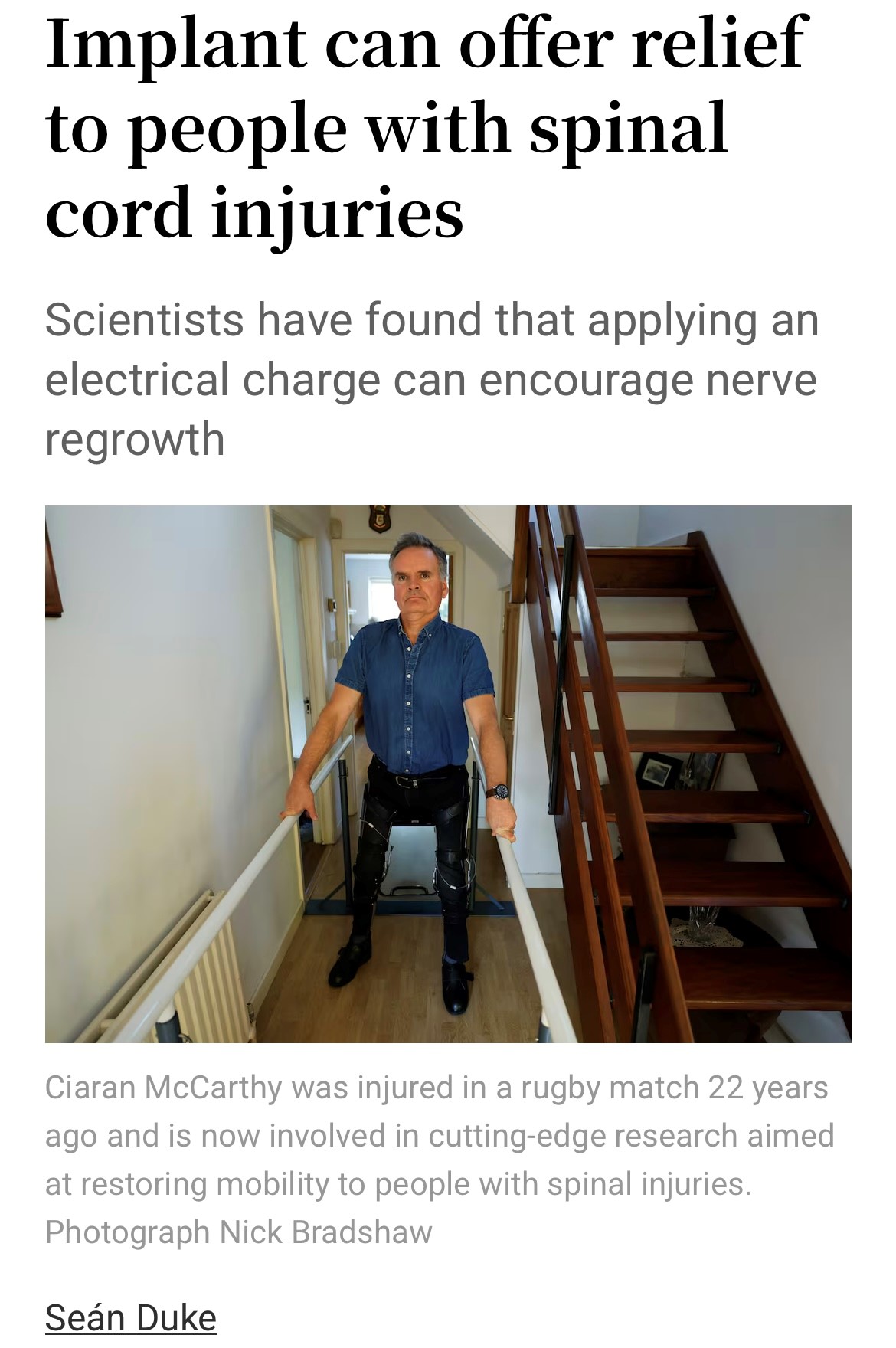
Ciaran McCarthy of the IRFU Charitable Trust became involved with the research as a patient public involvement researcher, and shares his story and the impact the research has had in the Irish Times linked below:
AMBER has a strong emphasis on collaboration. Central to AMBER’s research remit are collaborative projects performed with industry partners, and working with academic, industry and wider stakeholder on international and national research programmes.
Get in touch