Research Ireland Centre for Advanced Materials and BioEngineering Research
Follow




Global Innovation Index 2025 – Ireland ranks 18th
Increased investment in Research and Innovation in Budget 2026 can see Ireland break into the top 10 again
Ireland’s position of 18th on the 2025 Global Innovation Index (GII) announced this week is welcome, including Dublin’s new inclusion in the top 100 clusters and timely in advance of the Budget announcement next month.
In innovation leaders “Ireland rises one rank to 18th and solidifies its place within the top 20. It continues to benefit from its strong ICT sector, ranking 1st in ICT services exports and Intellectual property (IP) payments, 2nd in Intangible asset intensity, and 3rd in Software spending.”
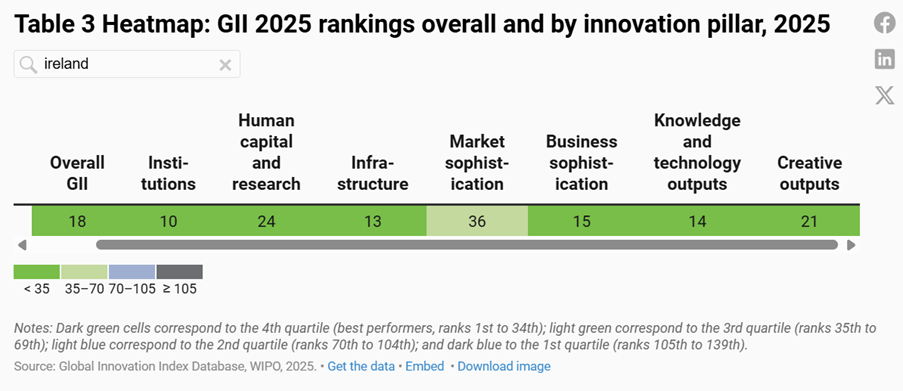
Figure sourced GII 2025 Results: Table 3 Heatmap: GII 2025 rankings overall and by innovation pillar, 2025, https://www.wipo.int/web-publications/global-innovation-index-2025/en/gii-2025-results.html
Whilst these results are positive for Ireland it cannot be ignored that the precarious ranking position over the years is indicative of a need for greater investment in research and innovation. Now on the 18th Edition of the GII, Ireland’s position in 2007 when it first began was 21st, breaking the top 10 in 2012 and placing 8th in 2015 however we are only now gaining momentum again having placed 23rd in 2022.
The government’s publication of the Action Plan on Competitiveness and Productivity earlier this month, with its explicit commitment to prioritise investment in national research infrastructure, raise GBARD per capita to the EU27 average, and strengthen the capacity of Irish-based enterprises to engage with the academic ecosystem, is both timely and welcome. These priorities align closely with the AMBER Centre’s Pre-Budget Submission 2026, which recommends a series of actions to position Ireland as a research and innovation leader among the five leading small, advanced economies (SAE-5: Denmark, Finland, the Netherlands, Belgium, and Austria), including but not limited to:
The Impact of increasing funding in Research and Innovation in Ireland
Taking AMBER’s research areas as an example, in a global context advanced materials are a primary driver of economic growth and competitiveness forming the basis of all modern technologies. From renewable energy to generative AI to advanced therapeutics, it is difficult to identify an emerging technology which does not have a critical dependency on innovation and adoption of advanced materials. Economic, geopolitical, and societal factors such as population growth, convergence of living standards and the mass adoption of digital and green technologies are driving an unprecedented demand for materials with the OECD forecasting an approximate twofold increase in the global demand for raw materials from 89 Giga Tonnes in 2017 to 167 Giga Tonnes in 2060, it is estimated that 70% of the innovations associated with the green and digital transitions will depend on materials research.
The importance of materials science to Ireland as a small export-led economy is significant and the need to nurture the sector is a pre-requisite for economic resilience and success. As one of the most globalised world economies heavily dependent on trade and foreign direct investment the Irish manufacturing sector is vulnerable to emerging developments in global value chains and protectionism policies. Irish enterprise, innovation and environmental policies place a high priority on transitioning the industry and research base to a low carbon, sustainable and innovation-driven model with increased international reputation and global competitiveness. A strong, internationally competitive materials science research, innovation, and education capacity, as embodied in the AMBER vision and mission, is pivotal to drive innovation in the areas of sustainability, circularity, and substitution technologies. These technologies will underpin future supply chains of our manufacturing industries and are an absolute necessity in delivering on our national priorities with respect to innovation, competitiveness, advancing our value proposition to FDI, strengthening our indigenous exporting sector, addressing climate change, and delivering an innovative healthcare system.
Read AMBER’s full PreBudget Submission 2026 Here
GII is published annually by the World Intellectual Property Organisation, a UN agency. It reviews the innovation performance of 139 countries globally across human capital, infrastructure, market and business sophistication.
AMBER has a strong emphasis on collaboration. Central to AMBER’s research remit are collaborative projects performed with industry partners, and working with academic, industry and wider stakeholder on international and national research programmes.
Get in touch